
Austria
Austria

Austria Travel Guide
Vienna is one of those cities through which you step into the past of Central Europe. Graz and Linz have historic old quarters and a pleasant, relaxed urban rhythm with cafés where I could easily spend an afternoon. Salzburg, meanwhile, is a picturesque Baroque city squeezed between mountains and lakes.
Austria is also easy to recognize from the cinematic scenery of The Sound of Music, where some of the most famous scenes were filmed. In summer, hiking takes the lead; in winter, skiing; and in between you constantly get the feeling of standing just above a lake where the mountains reflect in the water. What always strikes me about this country is its raw beauty. If you love hiking and skiing, it is hard to find many better corners in Europe.
- Best for: cities, the Alps, lakes, hiking, and skiing.
- For a first trip: Vienna, Salzburg, and one excursion into nature or to a ski resort.
- Vibe: well-organized, scenic, historic, and very seasonal.
- Ideal duration: 3–5 days for cities, 7–10 days for a wider circuit.
How to get around
Public transport in Austria
Public transport in Austria is clean, safe, and reliable. In larger cities, you have plenty of options, so getting around without a car is easy.
In Vienna, a one-way adult ticket for the tram, metro, or bus costs around €2.60. The metro runs roughly from five in the morning until midnight, and on Fridays and Saturdays it operates 24 hours a day. Some bus lines also run at night, roughly between 00:30 and 05:00. One important detail: the ticket must be validated in the machine before boarding.
In Graz, a one-hour tram ticket costs around €3, while in Salzburg, bus and tram fares start at about €2.30. Most cities also offer day passes. In Vienna, for example, a 24-hour pass costs €8, a 48-hour pass €14.10, and a 72-hour pass €17.10.
Trains
For getting around Austria, trains are probably the best choice. They are fast, relatively affordable, and efficient enough that they are often more worthwhile than driving. If you book early enough, you can get a ticket from Vienna to Graz, a journey of about two and a half hours, for around €25. The trip from Vienna to Salzburg takes about three hours, with fares starting at around €40.
Connections to nearby cities outside Austria are also convenient. Vienna–Prague takes about four hours and starts at around €40, while Vienna–Budapest takes about two hours and starts at around €30.
The Austrian night train, Nightjet, is also worth mentioning. It connects cities such as Salzburg, Vienna, Innsbruck, Bregenz, and Arlberg, and also runs to more than a dozen other countries. Seats to Berlin start at around €40, to Paris at around €60, while a sleeper compartment usually costs more than €100.
Vienna

Vienna was the city of the Habsburgs for centuries, so it is hardly surprising that almost every major turn reveals a new palace, museum collection, or grand façade. During the day, you admire lavish architecture; in the evening, you can end up by the Danube, where bars and clubs take over the waterfront in summer.
If I had to choose the classic stops, I would put Belvedere, Hofburg, and Schönbrunn on the list without hesitation. Belvedere is one of those Viennese sights you almost expect — and yet it still surprises you. Hofburg is not just a palace, but an entire world of museums, courtyards, and imperial history. Schönbrunn, meanwhile, comes with its former summer residence and a huge garden, which for me personally is one of the most beautiful parts of the city.
Vienna is not interesting only because of its major landmarks. Naschmarkt is also an excellent stop, with more than 120 stalls and food vendors, or MuseumsQuartier, a large arts and culture district where an entire afternoon can easily disappear. If you visit during Advent, the city gains another layer. Christmas markets are almost an institution here. Christkindlmarkt on Rathausplatz, in front of City Hall, is considered one of the largest and oldest in the world.
Salzburg
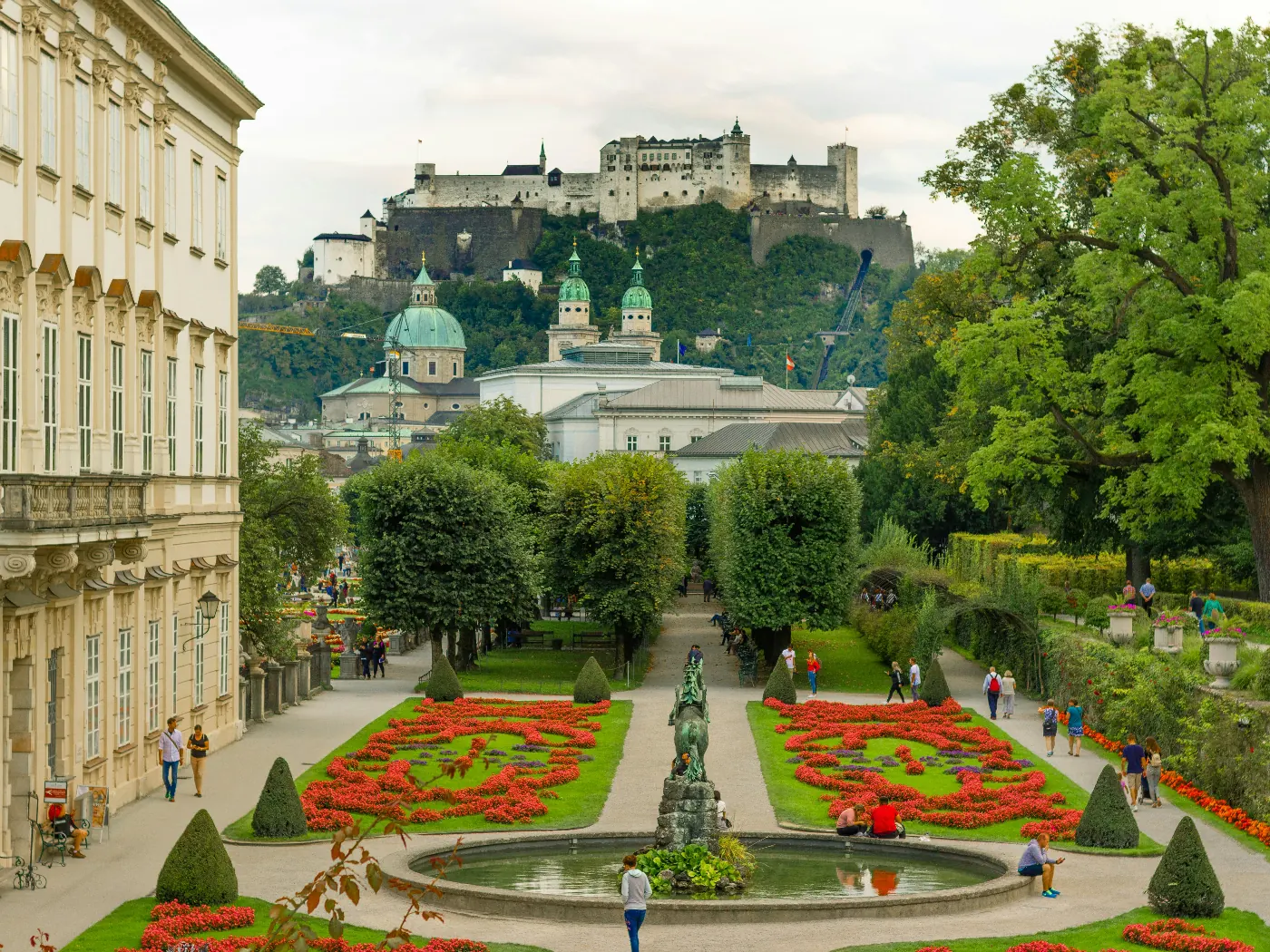
Salzburg is Mozart’s birthplace, and you can feel that almost everywhere. You can visit the house where he was born and stop for coffee at Café Tomaselli, where he once used to go.
The city is also closely connected to The Sound of Music, as some of its most famous scenes were filmed here, taking you along the trail of the Von Trapp family.
But Salzburg is not interesting only because of Mozart and the film. It has the 11th-century Hohensalzburg Fortress, the Renaissance palace Schloss Hellbrunn, beautiful walking routes, cobbled streets, inviting cafés, and views toward the Alps. All of it is tied together by a distinct Baroque elegance.
Hangar-7
A special stop just outside Salzburg’s old town, near the airport, is Hangar-7, an unusual museum and exhibition space run by Red Bull. The building is essentially a huge glass hangar displaying historic aircraft, helicopters, Formula 1 cars, motorcycles, and a range of experimental projects.
Among the exhibits is the famous Douglas DC-6B aircraft once used by Yugoslav president Josip Broz Tito. In addition to the planes, the hangar also features Formula 1 cars, various prototypes, and an exhibition related to extreme sports.
One of the more interesting elements is also a sculpture of Felix Baumgartner, the Austrian skydiver who became famous for his jump from the stratosphere in the Red Bull Stratos project.


Hallstatt

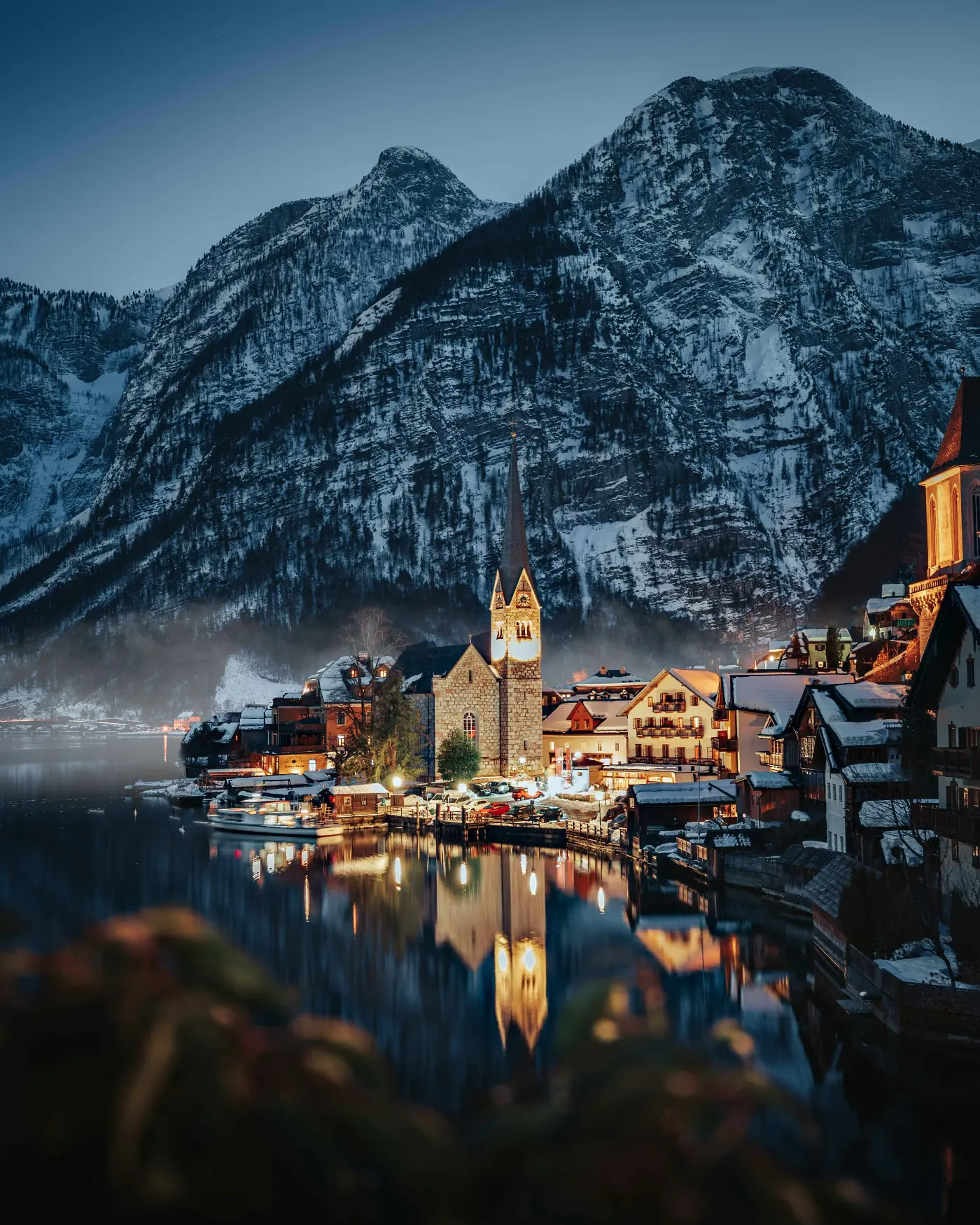
Hallstatt is almost the perfect day trip from Salzburg, as it lies about an hour away. It is a small, very picturesque village under UNESCO protection, and it is compact enough that you can genuinely experience it in a single day.
For the view, it is worth heading up to the viewing platform above the village. If heights are not your favourite thing, you probably will not feel entirely relaxed up there. The ascent takes about an hour on foot, but you can also take the Salzbergbahn Hallstatt funicular, which takes around five minutes. Nearby, you will also find the lake with swans, a waterfall, an ossuary with more than 6,000 decorated skulls, and the surrounding mountains, which offer plenty for lovers of greater elevation. You can also visit the nearby salt mines, considered the oldest in the world, or set out on a panoramic boat ride across the lake.
Hallstatt, however, is not only a destination in itself. It is also a very beautiful base for the wider Salzkammergut region, where lakes, forested mountains, and old villages line up so naturally that you quickly get the feeling one day is not enough.
Linz

Linz is the third-largest city in Austria and the capital of Upper Austria, located on the Danube. In December, the city centre transforms with Advent markets held in several locations. Hauptplatz, one of the largest town squares in Austria, stands out most. Within the wider urban route through Austria, Linz works well as a stop between Vienna and Salzburg.
In 2009, the city was awarded the title of European Capital of Culture, and today it hosts Ars Electronica, one of the leading centres for art, technology, and society. Then evening comes, and the city shows another side — concert-driven, raw, and unforgettable.
Beth Hart is an extraordinary American singer known for her raw vocals and emotionally charged performances. After the very first song, it was clear that the drive north to Austria had been more than worth it.
Graz

Graz’s old town is protected by UNESCO, and the numbers alone say enough: more than a thousand buildings stand here, many of them dating back to the Middle Ages. If you enjoy history and architecture, this is one of those city walks you do not want to rush.
The centre is very pleasant to explore: street cafés, galleries, shops, and enough life that the city never feels like a static exhibit. A beautiful view opens up from Schlossberg, the castle hill above the city, reached by 260 steps. A guided tour of the area will lighten your wallet by around €20.
Graz is Austria’s second-largest city, yet compared with Vienna it has noticeably fewer tourists. That can make it even more appealing to some. And to prevent the city from feeling too calm, its many universities give it a lively but unobtrusive energy — exactly the kind that fits well with its historic character.

Personal experience • Linz
AI, the human being, and the future — notes from Ars Electronica
A week in Linz that, alongside practical insights, delivered ultra-recreation for the brain and raised fundamental questions: who is winning — the human or the humanoid?
From smart cities to art without an author, from robots in restaurants to the industry of the future — Linz opens up the question of where we are actually heading.
Turracher Höhe

Turracher Höhe is a smaller but very well-organized ski centre with reliable snow conditions. With 43 kilometres of slopes, it offers perfectly decent recreational possibilities, while an altitude of up to 2,205 metres also ensures wonderful panoramic views. The ski area has 16 modern lifts, and almost the entire area is supported by a snowmaking system. One small drawback is that the pistes are not always marked especially well, but there are not many of them, so you quickly find your favourite.
You will enjoy Turracher Höhe most if you like wide, easy, and intermediate pistes, along with a slightly calmer skiing atmosphere. Prices here also tend to be a little friendlier than at Austria’s biggest ski resorts.
Bad Kleinkirchheim

Bad Kleinkirchheim offers a solid 100 kilometres of slopes. The resort lies within the Nockberge Biosphere Reserve and is known for its pleasant combination of skiing and wellness. One special advantage of the place is Thermal Römerbad, where after a day on the snow you are met by numerous saunas and thermal pools.
Katschberg

Katschberg lies between Carinthia and Salzburg and offers around 70 kilometres of groomed slopes and 16 modern lifts, with skiing taking place between roughly 1,640 and 2,220 metres above sea level. A major advantage of the resort is also its 100% snowmaking coverage, which ensures reliable conditions even in seasons with less natural snowfall. It is true, though, that skiing in March can quickly become less pleasant because of wetter and heavier snow.
Katschberg is often described as very family-friendly, while still being large enough that it is not interesting only for beginners.
Itineraries
3 days: Vienna
- Day 1: first feel for the city. Start in the old center: Stephansdom, Kärntner Straße, Graben, Hofburg, and a walk along the Ring. In the afternoon, add Naschmarkt or MuseumsQuartier; in the evening, head to Donaukanal if you want a more relaxed end to the day.
- Day 2: palaces and museums. Give the morning to Schönbrunn, the gardens, and the view by the Gloriette. In the afternoon, choose Belvedere or the Kunsthistorisches Museum, depending on whether you are more drawn to Klimt or to the classic museum story.
- Day 3: a slower Vienna. Choose the Prater, coffee in a classic Viennese café, another museum, or a walk along the Danube.
5 days: Vienna, Salzburg, and Hallstatt
- Day 1: Vienna, first impression. The old center, Hofburg, the Ring, Stephansdom, and an evening walk through the city center.
- Day 2: Vienna. Schönbrunn in the morning, then Belvedere or MuseumsQuartier in the afternoon.
- Day 3: train toward Salzburg. Travel from Vienna to Salzburg in the morning; spend the afternoon in the old town, Mirabell Gardens, and Hohensalzburg Fortress.
- Day 4: Hallstatt or Salzkammergut. From Salzburg, make a full-day trip to Hallstatt or the wider Salzkammergut region.
- Day 5: Salzburg or Linz. If you are heading back toward Vienna or farther north, Linz works well as a stop between the two: Ars Electronica, the Danube, and a city evening.
7 days: classic Austria
- Day 1: Graz. If you are arriving from Slovenia, Graz is the logical first stop: the old town, Schlossberg, coffee, and an evening in the center.
- Day 2: Vienna. Move on to Vienna and walk through the inner city, the Ring, Hofburg, and Stephansdom.
- Day 3: Vienna. Schönbrunn, Belvedere, Naschmarkt, or MuseumsQuartier.
- Day 4: Linz. A natural transition between Vienna and Salzburg: the Danube, Hauptplatz, and Ars Electronica.
- Day 5: Salzburg. Mirabell, the old town, the fortress, Mozart’s story, and Hangar-7 if you feel like adding it.
- Day 6: Hallstatt or Salzkammergut. Choose Hallstatt, Bad Ischl, or the lakes of Salzkammergut. It works best as a full-day trip, not as a quick stop between two long drives.
- Day 7: return with room to breathe. Head back toward Slovenia via Salzburg, Carinthia, or Graz. Keep the final day loose, especially if you are traveling in high season, in winter, or around the holidays.
9 days
- Day 1: Graz. Start Austria with the old town and Schlossberg.
- Day 2: Vienna. Arrive in Vienna, then take in the Ring, Hofburg, and the old city center.
- Day 3: Vienna. Schönbrunn, Belvedere, museums, or Naschmarkt. Vienna needs at least two full days if you do not want to just skim across it.
- Day 4: Vienna or a day trip. Add a third city day or a shorter excursion.
- Day 5: Linz. Move toward Linz and Ars Electronica.
- Day 6: Salzburg. Mirabell, the old town, Hohensalzburg, and a café stop.
- Day 7: Hallstatt and Salzkammergut. Hallstatt, the lake, and the salt mine if you want it. If it is crowded, widen the day to Bad Ischl or Wolfgangsee.
- Day 8: an Alpine day. In summer, choose lakes, hiking, or a panoramic drive; in winter, skiing or time in the thermal baths.
- Day 9: Carinthia or ski resorts. You can include Bad Kleinkirchheim, Turracher Höhe, or Katschberg.
Austria practical tips
Car tips
Passenger cars up to 3.5 tons need a vignette for Austrian motorways and expressways. In 2026, a car vignette costs €9.60 for 1 day, €12.80 for 10 days, €32.00 for 2 months, and €106.80 for a year. The 1-day vignette is digital only.
- For a short trip: the 1-day or 10-day vignette is usually enough.
- Digital vignette: the 1-day and 10-day versions can be valid immediately; for 2-month and annual vignettes bought online by private individuals, allow for the 18-day delay.
- Additional tolls: some Alpine sections are charged separately, even if you already have a vignette.
- Key sections: A9 Gleinalm/Bosruck, A10 Tauern/Katschberg, A11 Karawanken, A13 Brenner, and S16 Arlberg.
Driving
Austria is very orderly to drive in, but driving rules, fines and restrictions are not something to take lightly. In cities, expect limits, parking zones and less space; in the Alps, count on weather, tunnels, traffic jams and seasonal conditions.
- Speed limits: generally 50 km/h in built-up areas, 100 km/h outside built-up areas, and 130 km/h on motorways, unless signs say otherwise.
- Phone: use it only hands-free while driving.
- Seat belt: mandatory for the driver and passengers.
- Alcohol: the general limit is 0.5‰; stricter rules apply to novice and professional drivers.
Public transport
Between larger Austrian cities, the train is often a better choice than the car. Vienna and Salzburg are connected by direct trains, and ÖBB offers cheaper Sparschiene tickets when you book early.
- Vienna–Salzburg: a good direct connection, useful for a 5- or 7-day itinerary.
- Vienna: check the current public transport tickets before you travel.
- Important: compare a single ticket, 24-hour ticket, 7-day ticket or Vienna City Card depending on how long you stay.
- Paper ticket: validate it at the machine before your first ride.
Hallstatt and Salzkammergut
Hallstatt works best when you do not treat it as a quick stop between two long drives. It is part of the wider Dachstein Salzkammergut region, where lakes, mountains, old villages and UNESCO heritage fit naturally into a slower trip. Bad Ischl is a useful transport hub and a worthwhile stop in its own right.
- Best approach: go early or sleep in the region if you want a calmer pace.
- From Salzburg: by car is the simplest; by public transport is doable, but allow more time and transfers.
- Alternative to the crowds: Bad Ischl, Wolfgangsee, St. Gilgen, or other lakes in Salzkammergut.
Costs and reservations
Austria is not the cheapest destination, but costs vary a lot by season. Vienna and Salzburg are more expensive during Advent, Hallstatt and the lakes in summer, and ski resorts during school holidays and good snow conditions.
- Accommodation: book earlier for Advent, summer by the lakes, and winter ski dates.
- Tickets: check time slots in advance for major museums, palaces, salt mines and popular tours.
- Food: on a lower budget, combine markets, bakeries and simple local inns.