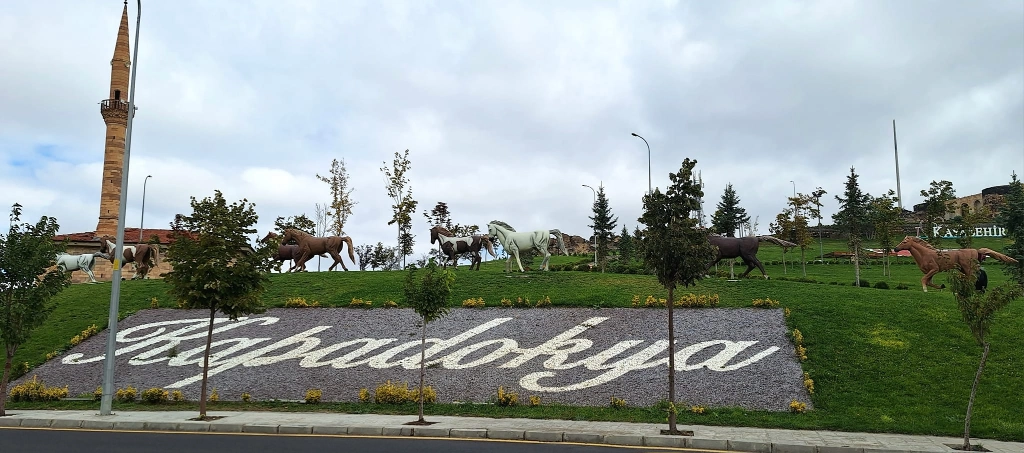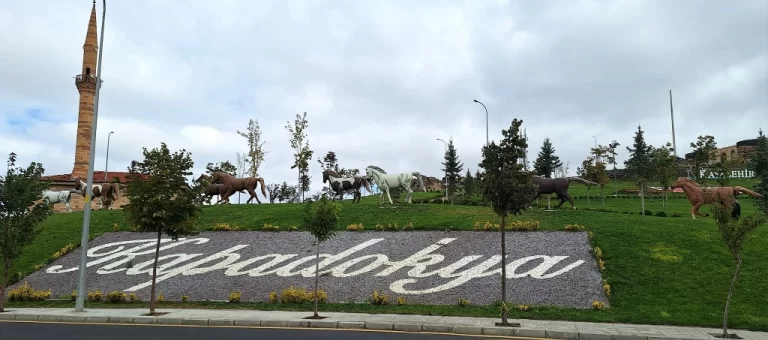
Marhabi, Konya
After three days, we confidently greet everyone with a cheerful “marhabi” –
don’t worry, I’m your friend. As Haris likes to remind us, we are not tourists here.
We are locals. And the people around us are not hosts – they are friends.
Our morning wake-up call? Definitely not something you’d download as a ringtone.
At exactly 5 a.m., the call to prayer rises through the dark – louder and far more persistent
than any phone alarm. Long before the first rooster even considers doing his job 🙂
Konya Under Watchful Skies
Konya had welcomed us the day before – quite literally under escort.
Six military helicopters hovered above in perfect formation.
There’s a NATO base nearby, where pilots regularly train.
And, as we jokingly said, perhaps keep an eye on us as well 🙂
With nearly two million residents, Konya isn’t exactly known for its nightlife.
More than 99.5% of the population is Muslim, yet the streets feel surprisingly calm
for a city of that size. Official unemployment hovers below two percent –
and judging by the steady pace of life, people here clearly know how to make things work.
“In this city, everyone works,” Haris says with a knowing smile.
And there might be truth in that. Konya is the largest city in Turkey by surface area
and boasts more than 3,300 mosques. Some of them are architectural gems –
elegant minarets rising like pearls from the concrete of modern apartment blocks.
Tastes of Konya
Only a handful of restaurants serve Turkish rakı, yet statistics say
this region leads the country in alcohol consumption per capita.
Appearances can be deceiving.
But Konya is not about alcohol. It’s about flavor.
There’s “şalgam,” a deep-purple fermented turnip juice with a sharp kick,
and “salep,” a thick, comforting milk drink flavored with ground orchid root –
something between vanilla pudding and a winter hug in a cup.
And then there’s baklava. Anyone who has tried it knows it’s practically a meal on its own.
According to Haris, after a proper portion you could climb a wall without breaking a sweat 😁
After Ramadan, production numbers skyrocket into the tens of thousands of tons.
From Gaziantep – the sweet capital where baklava originates –
up to 52,000 tons are distributed across Turkey in just four days.
After a feast like that, perhaps the only logical next step is to buy a rare local dog breed
for €14,000 and spend three days walking it through the surrounding hills.
In Konya, even exaggerations somehow feel believable.