
Bosnia
Bosnia and Herzegovina
Bosnia and Herzegovina at a glance
Bosnia and Herzegovina is compact enough for a short road trip, but layered enough to feel like several journeys in one: Sarajevo for history, Mostar for the postcard moment, Herzegovina for rivers and limestone landscapes, and Neum for a quick touch of the Adriatic.
spring / early autumn
ćevapi and Bosnian coffee
convertible mark (BAM / KM)
For a first visit, the easiest route is Sarajevo, Mostar, Blagaj and one nature stop in Herzegovina. In three or four days, you already get the main rhythm of the country: old bazaars, Ottoman bridges, Austro-Hungarian facades, river valleys and slow coffee breaks that somehow become part of the plan.
If you have more time, add Počitelj, Kravica, Višegrad, Sutjeska National Park or Neum. The distances are not huge, but the landscapes change quickly, so Bosnia works best when you leave a little room between the stops.


Guide to Bosnia
Use the map as a simple regional guide. The most natural starting point is Sarajevo Canton, where Sarajevo gives you the clearest first impression of the country: Baščaršija as the old Ottoman trading quarter, Vijećnica as the Austro-Hungarian city hall from 1896, Vrelo Bosne near Ilidža and the Tunnel of Hope from the siege of Sarajevo.
South of Sarajevo, the trip moves into Herzegovina. In Herzegovina-Neretva Canton, Mostar and Blagaj are the key stops. Mostar developed as an Ottoman frontier town in the 15th and 16th centuries, and its Old Bridge Area is now the most recognizable sight in the country. In strong travel years, the city welcomes well over a million visitors, most of them drawn to the Old Bridge and the old town.
Blagaj is the quieter stop in the same region, set at the spring of the Buna River beneath steep cliffs. Farther south, Počitelj sits above the Neretva as a historic stone settlement on the road toward Čapljina. If you continue west, you enter West Herzegovina Canton, where Kravica Falls near Ljubuški form a natural amphitheater on the Trebižat River.
On the eastern side of the country, in Republika Srpska, Višegrad adds another important Ottoman layer with the Mehmed Paša Sokolović Bridge over the Drina River, a late-16th-century UNESCO-listed bridge. The map also marks Neum, Bosnia and Herzegovina’s only coastal town — a small but useful seaside pause if your road trip continues through southern Herzegovina.
Worth experiencing
Sarajevo
Sarajevo is the best first contact with the country: Baščaršija, Bosnian coffee, views above the valley and places where history does not hide. For a first visit, Baščaršija, Vijećnica, the Gazi Husrev-beg complex, Vrelo Bosne and the Tunnel of Hope all work very well.
Mostar
Mostar is much more than just one photograph of the Old Bridge. The historic core developed in the 15th and 16th centuries, and today the Old Bridge and the old town are protected by UNESCO. It is at its best early in the morning or towards the evening, when there are fewer crowds and the light is softer.
Nature
Blagaj at the source of the Buna is one of the most photogenic stops, while the Kravica waterfalls on the Trebižat River are excellent for a short break or a swim in the warmer months. If you have more time, it is worth making a detour to Sutjeska National Park (the oldest in the country, with the option of hiking Maglić – the highest peak in Bosnia) or to Vjetrenica Cave near Ravno, one of the best-known karst caves in the region.
Neum
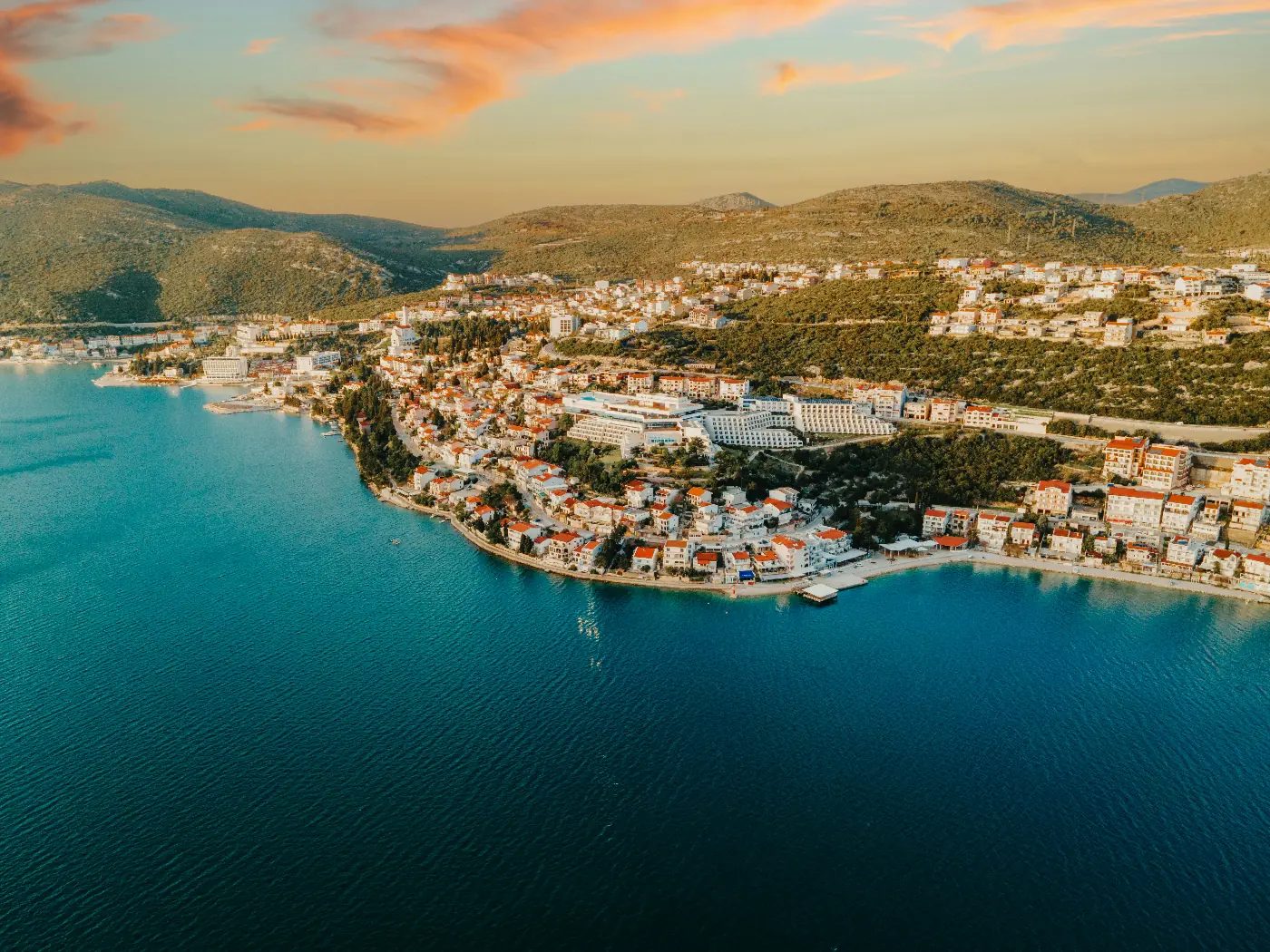
Neum is not just a transit point between borders. It is the only coastal town in Bosnia and Herzegovina and a good mini stop if you want your road trip to include a little sea, or just a walk along the waterfront.

Trip idea
- Day 1: Sarajevo and Baščaršija. Walk through the old core, visit the Gazi Husrev-beg Mosque and try Bosnian coffee. End the day with a view from one of the points above the city (for example Trebević or Yellow Fortress).
- Day 2: A deeper look into Sarajevo: Vijećnica (the restored city hall), the Tunnel of Hope as a key site from the siege of the city, or Vrelo Bosne as a natural park at the source of the Bosna River. Spend the evening back in the centre, when the city slows down a little.
- Day 3: Drive towards Mostar (around 2–2.5 hours). Stop in Blagaj at the source of the Buna and visit the 16th-century tekke beneath steep cliffs. In Mostar, walk across the Old Bridge (UNESCO) and through the old town.
- Day 4: Choose according to your pace: the Kravica waterfalls on the Trebižat River (swimming in season), or Vjetrenica Cave near Ravno, known for its karst features and stable temperature throughout the year. You can finish the day in Neum, the country’s only coastal town.
Neum
Many people know Neum mainly as an “in-between stop” on the way further south. But if you take a few hours or one night there,
you get a different feeling. A genuine Mediterranean touch, a few walking routes along the coast and the option of various outdoor activities.
- Best plan: a Bosnian lunch and a walk by the sea.
- If you stay overnight: off-season around €30–60, July–August often €60–120 or more.
- Outdoor activities: water sports (kayak, jet ski, pedal boat).
Neum is not just a summer beach stop, but also a base for cultural events — the international animation and underwater film festivals (the combination alone is interesting), Neum Summer Festival and Ethnofest Neum. On this page, it is not just a transit note, but a meaningful mini stop on a journey through Herzegovina.
Bosnia practical tips
Documents
Slovenian citizens can enter Bosnia and Herzegovina with a valid passport or identity card. If you are not a Slovenian or EU citizen, check the visa regime before departure.
- For Slovenian citizens: a valid identity card or passport.
- Official source: check the Slovenian Police information on documents for crossing the border.
- Visa regime: check the official Bosnia and Herzegovina visa information before travelling.
- Children: every child needs their own identity document.
- Driving route: keep your document close at hand, especially if you combine BiH with Croatia, Montenegro or Serbia.
Arrival
The most natural base for a first visit is Sarajevo. If you arrive by plane, check your arrival time, transfer to the city and late check-in options before booking accommodation. Visit Sarajevo lists the airport bus and other transport options between Sarajevo International Airport and the city.
- Sarajevo: the most logical starting point for a first visit to the country.
- Airport transfer: check arriving to Sarajevo before departure.
- Tuzla, Banja Luka or Mostar: these can also work depending on the season and flight connections, but they require more transfer planning.
- Late arrival: check taxis, hotel transfers or rental-car pick-up in advance.
- First day: do not plan too much; in BiH it is better to catch the rhythm than to start chasing kilometres immediately.
Transport between cities
Buses connect the larger cities, and on the Sarajevo–Mostar route the train can also be an option. For Herzegovina outside the main towns, a car or an organised trip is often much more practical.
- Sarajevo–Mostar: check buses and the official Railways of the Federation of Bosnia and Herzegovina timetable for your specific travel day.
- Blagaj, Kravica, Počitelj: easiest by car, local tour or private transfer.
- Jajce, Travnik, Trebinje: possible by public transport, but with less spontaneity.
- Practical tip: have a plan B, especially for the last daily connections and for moving between cities and natural sights.
Roads and tolls
Bosnia and Herzegovina does not use a classic vignette system. On motorway sections, tolls are paid according to the distance travelled, usually at toll stations. JP Autoceste FBiH states that tolls on the A1 motorway are charged based on the distance between toll stations and vehicle class.
- Tolls: check the official motorway toll information before longer drives.
- Payment: at toll stations, payment is generally possible by cash, accepted cards or subscription/ACC systems.
- Driving route: allow extra time for roadworks, border crossings and mountain sections.
- Winter: conditions can change quickly, especially outside the main routes.
Driving tips
A car is very useful for a trip through Herzegovina, while in Sarajevo it can be more of a nuisance because of traffic, parking and narrow streets. When driving, always follow local signs, because speed limits and conditions can change quickly.
- Built-up areas: often 50 km/h, unless signs indicate otherwise.
- Outside built-up areas: often 80 km/h; on roads reserved for motor vehicles, it can be 100 km/h.
- Motorways: often up to 130 km/h, but always follow the signs.
- Phone: using a handheld phone while driving is not a good idea; prepare your navigation before setting off.
- Parking: in Sarajevo and Mostar, check accommodation parking before booking.
Insurance
Arrange travel and health insurance before travelling to Bosnia and Herzegovina. ZZZS states that in Bosnia and Herzegovina you can claim emergency treatment with the European Health Insurance Card or Provisional Replacement Certificate and the corresponding accompanying letter, but this is not a substitute for proper travel assistance coverage.
- European card / certificate: check urgent and unplanned treatment abroad before departure.
- Commercial insurance: sensible because of assistance, repatriation, luggage, trip cancellation and private services.
- Before departure: save your policy number, assistance contact and copies of documents offline.
- Activities: for hiking, rafting or more remote areas, check what your insurance actually covers.
Currency
The official currency is the convertible mark (BAM/KM). The exchange rate is fixed to the euro at 1 EUR = 1.95583 KM, which makes conversion quite simple. Cards often work in cities, but you should still carry some cash.
- Currency: convertible mark, marked as BAM or KM.
- Official rate: the Central Bank of Bosnia and Herzegovina explains the fixed KM to EUR exchange rate.
- Cash: useful for smaller restaurants, parking, markets, tips, public toilets and smaller accommodation.
- Cards: common in Sarajevo and Mostar, but in smaller places do not rely on them alone.
- Reserve: on a driving route, add some extra room for taxis, fuel, tolls, parking or a change of plan.
Useful tips
Bosnia and Herzegovina is not part of the EU, so check your mobile plan, data roaming and possible charges before departure. For a driving route, prepare offline maps, because the signal outside cities is not always equally reliable.
- Phone: check roaming or consider a local SIM/eSIM if you will use navigation a lot.
- Maps: save Sarajevo, Mostar, Herzegovina and your return route offline.
- Electricity: 230 V; European type C/F plugs are usually used.
- Clothing: for religious sites and historical places, choose a respectful outfit.
- Summer: Herzegovina can be very hot; water, a hat and a slower pace are not an exaggeration.
Emergency numbers
Save emergency numbers before the trip, together with your insurance contact, assistance number, accommodation details and copies of documents. On a driving route, keep this information available offline as well.
- 122: police.
- 123: fire brigade.
- 124: emergency medical assistance.
- Source: check emergency services in Bosnia and Herzegovina.
Gallery


